
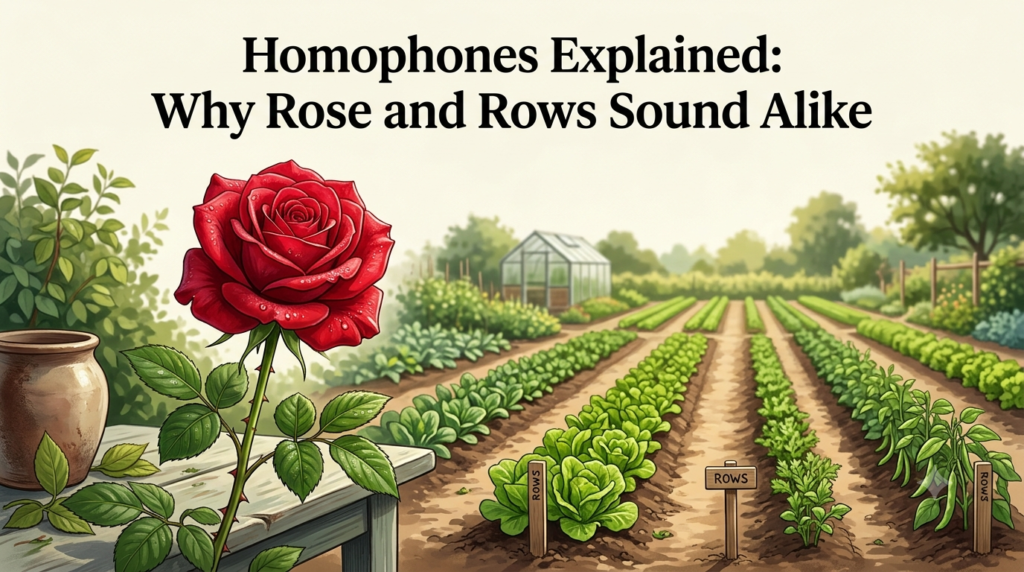
Homophones Explained: Why Rose and Rows Sound Alike
Homophones are words that sound alike but differ in meaning, and often in spelling, such as “rose” and “rows.” They are a classic trap in writing, and learning to spot them improves both your spelling and your reading comprehension.

What Is a Homophone?
The word comes from Greek: homos (“same”) and phone (“sound”). A homophone is one of two or more words that are pronounced alike but differ in meaning, and often in spelling.
Consider this sentence: “He gave her a red ___ on Valentine’s Day.” The answer is rose, the flower. But rows, meaning lines of things, sounds exactly the same. Only context tells you which word belongs.

Homophones, Homographs and Homonyms
These three terms are easy to confuse:
- Homophones sound the same but have different meanings (rose/rows).
- Homographs are spelled the same but have different meanings, and may sound different (a lead pipe / to lead the way).
- Homonyms are spelled and sound the same but have different meanings (the bank of a river / a bank for money).
Why English Has So Many
English borrowed heavily from Old English, French, Latin and Norse. Printing helped fix spellings in the 1400s and 1500s, but pronunciation kept changing. Words that once sounded different, like knight and night, drifted into the same sound while keeping separate spellings. The result is a language full of look-different, sound-alike pairs.
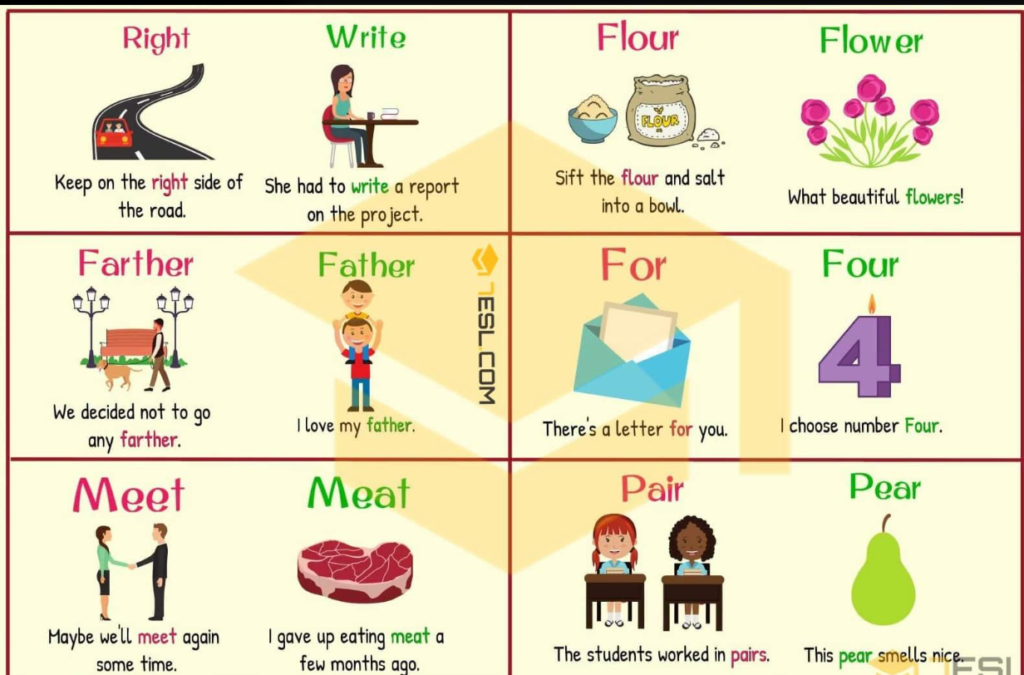
Common Homophones to Know
Homophones | What each means |
|---|---|
their / there / they’re | belonging to them / a place / they are |
to / too / two | toward / also / the number 2 |
your / you’re | belonging to you/you are |
its / it’s | belonging to it/it is |
write / right | put words on paper / correct, or a direction |
weather / whether | outdoor conditions / if |
flour/flower | a baking ingredient / a plant’s bloom |
rose / rows | a flower, or past tense of “rise” / lines of things |
Tricks for Telling Them Apart
- Check the context. Ask which meaning the sentence needs, then pick the matching spelling.
- Expand contractions. If “it is” or “you are” fits the sentence, use it’s or you’re. If not, use its or your.
- Build memory hooks. Stationery (paper) has an “e” like envelope. Your principal is your pal.
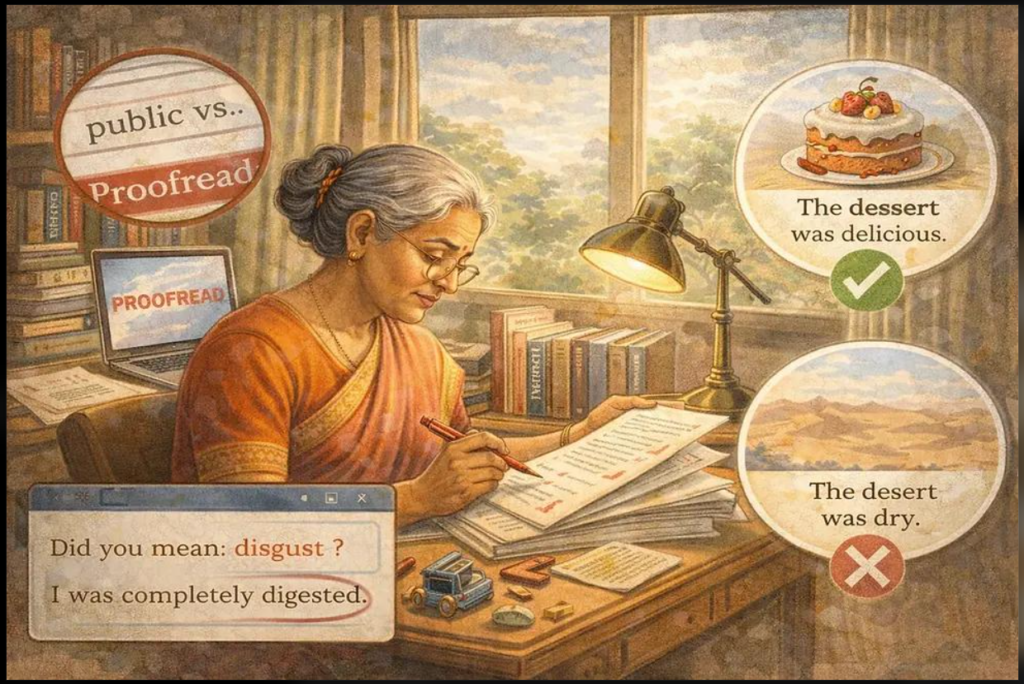
- Proofread aloud and on paper. Spell-checkers often miss homophones because both words are real words.
Why Homophones Matter
Mixing them up can change your meaning or make writing look careless. Writing “Your welcome” instead of “You’re welcome” is a common example. Homophones also power puns and riddles: “Why was six afraid of seven? Because seven ate nine.” The joke works only because ate sounds like eight. For language learners, they also train careful listening, since the ear alone can’t tell the words apart.
Quick Practice
Choose the correct word for each sentence:
- The farmer planted corn in neat ___ (rows/rose).
- I don’t know ___ it will rain tomorrow (weather / whether).
- ___ going to bring ___ books (they’re / their).
Answers: rows; whether; They’re, their.
The Bottom Line
Homophones are one of English’s most common stumbling blocks, but they get easier with practice. Learn the usual suspects, use the tricks above, and always check meaning against context. Before long, you’ll know instantly whether to hand over a rose or plant a few rows.